
Fort Worth is now large enough to carry the obligations and complexity of a major American city.
Rights Require Routes
Tarrant County Court Access Evidence Hub
A documented, media-facing overview of ADA Title II access-route concerns in Tarrant County courts. The frame is simple: A Right Without a Route Is Not Access. Participation is the measure, because a right is not meaningful if disabled court users cannot identify the route for requesting, receiving, and reviewing accommodations.
Civic scale
This is not a niche access issue. It is basic courthouse infrastructure.
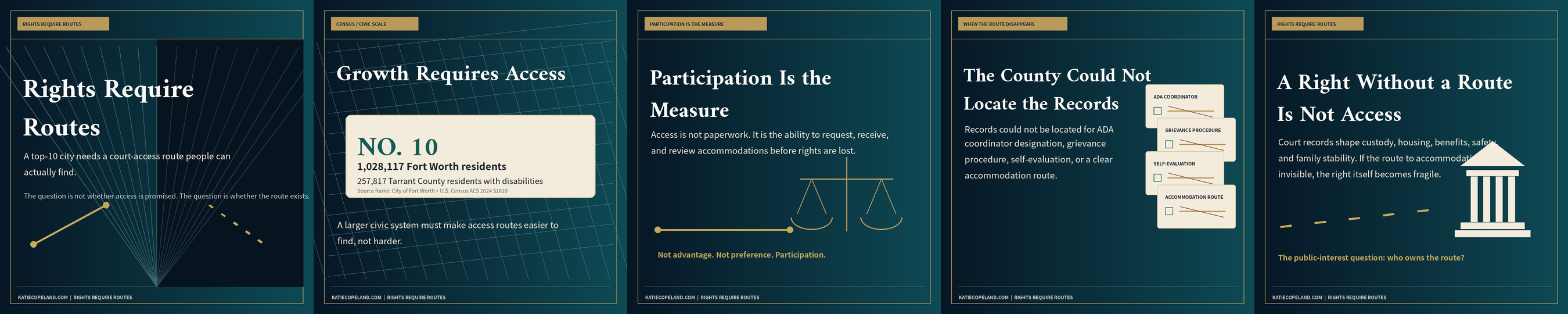
Tarrant County sits inside one of the fastest-growing civic landscapes in the country. Fort Worth has reported a population of 1,028,117 residents and identifies itself as the 10th-largest city in the United States. The U.S. Census Bureau’s 2024 ACS S1810 disability table estimates 257,817 Tarrant County residents with disabilities. Court access is therefore not a special exception to ordinary government service. It is part of the ordinary design of justice.
The verified ACS 2024 S1810 figure shows the scale of people for whom accessible public systems matter.
ADA Title II applies to state and local governments, including public services and programs that determine court access.
The documented access gap
The concern is not whether a courthouse has a promise of access. The concern is whether people can find and use the route.
The materials collected here focus on infrastructure: ADA coordinator identification, grievance procedures, self-evaluation records, accommodation routing, and the practical handoff between county administration and individual courts. The central public question is restrained and concrete: when a disabled court user asks for access, who receives the request, who evaluates it, who communicates the decision, and what review path exists if the route breaks down?
“Participation Is the Measure.”
This page uses participation, not paperwork, as the test. Policies matter because they create the route. If the route is invisible, fragmented, or undocumented, access becomes fragile for the people most likely to need clarity.
Coordinator and grievance infrastructure
Records gathered for this page identify gaps concerning centralized ADA coordinator information, grievance procedures, and the practical process for escalating access concerns.
Self-evaluation records
ADA Title II self-evaluation materials are foundational because they show whether a public entity has examined barriers in its own programs and services.
Accommodation routing
The evidence highlights a recurring problem: disabled court users may be directed between county administration and individual courts without a clearly owned, accountable route.
Digital and physical access
Modern court access includes physical buildings, records systems, websites, communications, hearing logistics, and forms. A fragmented route can become a real barrier.
Civic access frame
A Right Without a Route Is Not Access.
Access is not a courtesy. It is the doorway to due process. The missing pathway is therefore not a technical footnote; it is the story. If a person cannot tell where to request help, who owns the decision, how the response will be communicated, or where review exists when the route breaks down, the right may exist on paper while remaining unusable under pressure.
No coordinator, no clear doorway.
When public-facing ADA coordinator information is hard to locate or practically fragmented, disabled court users may be left guessing where to begin.
No grievance route, no review path.
A right needs a usable route for raising concerns when an accommodation decision, delay, or breakdown prevents meaningful participation.
No owned process, no reliable record.
If responsibility moves between offices without a clear handoff, blocked communication can become missing evidence, and missing evidence can become the record.
“Access cannot depend on the judge you draw, the clerk who answers, or the parent’s capacity to decode the system while already under stress.”
The public-interest question is not whether access is valued in theory. The question is whether the route is visible, owned, and usable when the person needs it.
National civil-rights context
Access to justice is disability access.
The Department of Justice has emphasized that state and local governments must make their services, programs, and activities accessible to people with disabilities. In court systems, that principle is not abstract. It affects custody, housing, benefits, safety, liberty, and family stability. The question is not whether access sounds good in principle. The question is whether the public can use it under pressure.
Reader pacing note: This subject can be heavy. The purpose of this hub is to reduce confusion, not increase alarm: one page, clear documents, and a focused question about whether public rights have usable public routes.
For parents building the record
A record is not justice. But it keeps injustice from disappearing.
The evidence hub is designed for public verification. A companion reflection speaks to parents and caregivers who are still inside systems that feel impossible to move: survive, document, tell the truth clearly, and preserve the pattern without becoming consumed by it.
“If all you can do right now is endure and keep the record, keep going.”
This note is intentionally quieter than the evidence packet. It is a steadiness piece for parents who need encouragement, not escalation.
Document index
Starter documents for reporters, researchers, and civic stakeholders
The leanest starting point is the fact sheet with evidence, followed by the DOJ context sheet. Additional records are included for deeper review. This page is organized to support verification, not overwhelm.
Copeland v. Tarrant County fact sheet with evidence
A concise overview of the court-access issue, timeline, and supporting records.
DOJ: access to justice is disability access
A national-context fact sheet connecting ADA Title II access to the administration of justice.
System failure: ADA accommodation processing in Tarrant County courts
A focused document on the practical routing problem and why an unclear process can become an access barrier.
Tarrant County ADA violations overview
Additional documentation and narrative framing for the access-route concerns.
For civil rights counsel and amici
This case is in active federal litigation — and seeking representation.
The civic evidence hub above is public education. The underlying litigation — Copeland v. Tarrant County, et al., No. 26-10389 (5th Cir.) — presents the same structural question as a live federal case, with a Rule 22.4 renewal pending before Justice Sotomayor (No. 25A1368). A separate counsel-and-amicus review portal provides the complete indexed record, doctrinal map, and representation asks for attorneys evaluating the case.
Media and civic inquiry
The public-interest question is narrow, verifiable, and urgent.
In a county serving hundreds of thousands of disabled residents, the justice system should be able to identify the route for requesting accommodations, reviewing denials or breakdowns, and documenting responsibility. That is the heart of this hub. A right without a route is not access; rights require routes, and participation is the measure.