
Copeland v. Tarrant County
No. 26-10389 (5th Cir.) · No. 4:25-cv-00890-O (N.D. Tex.) · U.S. Sup. Ct. No. 25A1368
This portal is prepared for civil-rights counsel, disability-rights advocates, and potential amici. It presents a structural Title II access-to-courts question — the "Closed Loop" — in which a county court system's documented absence of ADA administrative infrastructure made meaningful access to the courts unavailable to a disabled litigant, and the resulting exclusion was never reviewed on the merits at any level.
The Question Presented
Whether a county's failure to establish any of the administrative infrastructure required by 28 C.F.R. § 35.107 — a designated ADA coordinator, a self-evaluation, and a grievance procedure — constitutes a per se violation of Title II of the Americans with Disabilities Act, and whether a disabled litigant who was denied meaningful access to court proceedings as a result has standing to seek prospective injunctive relief without first exhausting a grievance process that does not exist.
No circuit has squarely decided whether § 35.107's administrative obligations — coordinator, intake, grievance — extend to court-participation accommodations. This record presents that question with the County's own written admissions as the evidentiary foundation.
The plaintiff is a licensed Texas attorney (State Bar No. 24086056) and ABA-published author on disability accommodation in state courts. The record has been organized for handoff to counsel. She is seeking representation precisely because she understands what this case requires — including that it should not be litigated from crisis mode, pro se.
In the County's Own Words
Every quotation in the graphics below is verbatim from the County's written communications and open-records responses, or from certified court transcripts. Click any graphic to view full size.
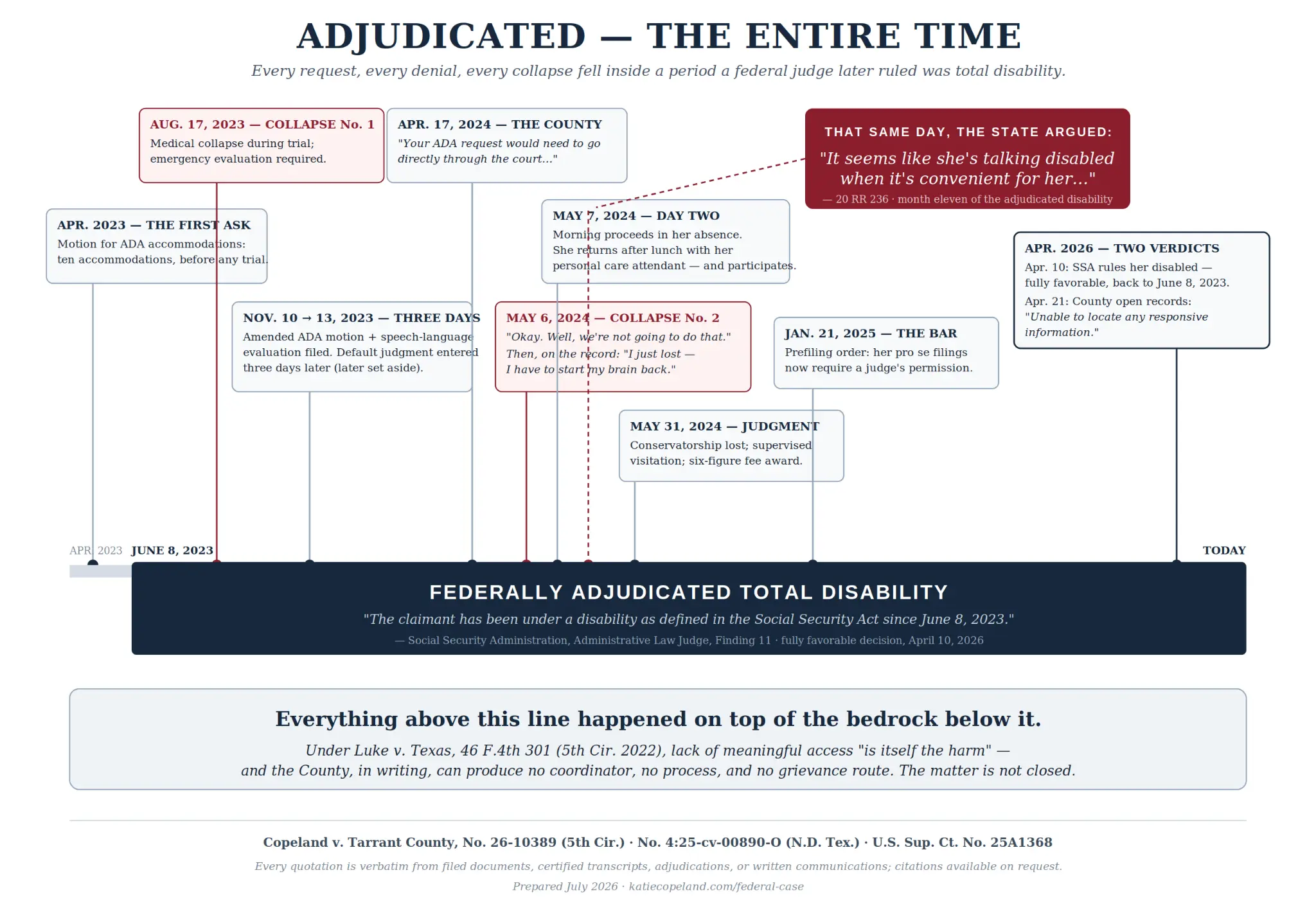
Every event above this line occurred inside the period the Social Security Administration adjudicated as total disability (onset June 8, 2023). — ALJ Finding 11, fully favorable decision, April 10, 2026. Every quotation verbatim from filed documents and certified transcripts.
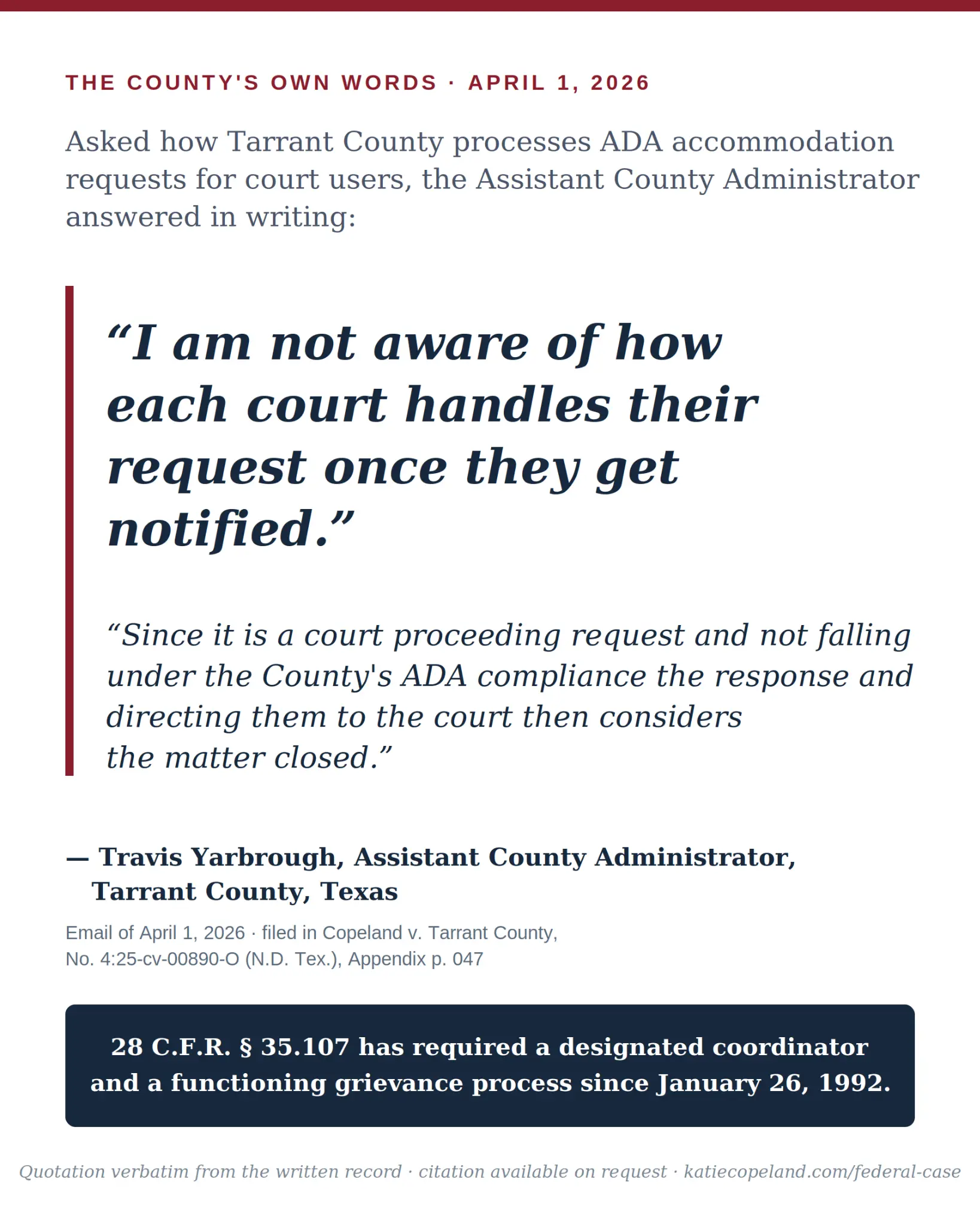
Travis Yarbrough, Assistant County Administrator, Tarrant County — email of April 1, 2026, filed in Copeland v. Tarrant County, No. 4:25-cv-00890-O (N.D. Tex.), Appendix p. 047.
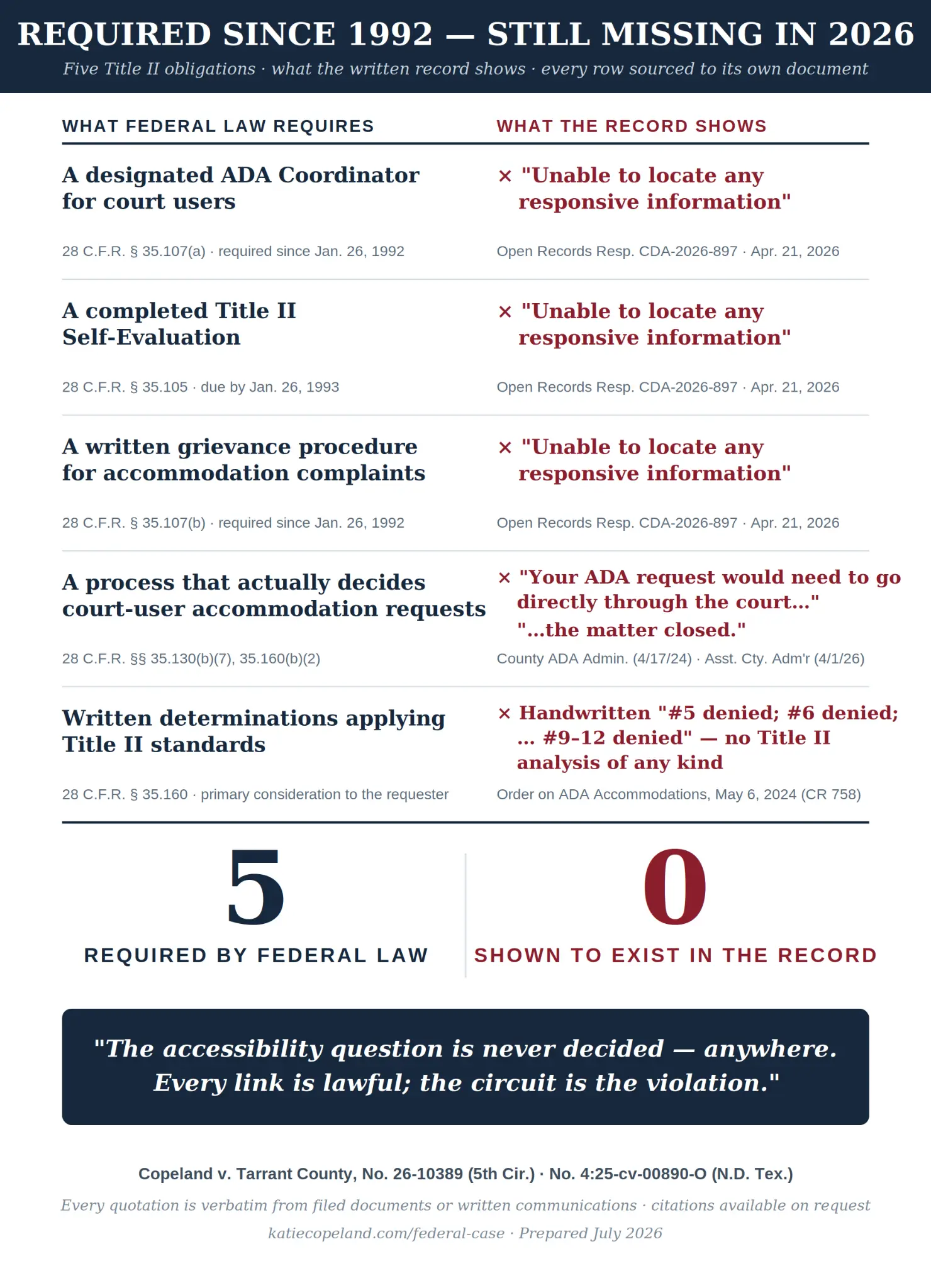
Five Title II obligations required since January 26, 1992 — and what the County's open-records response (CDA-2026-897, April 21, 2026) shows for each. Every row sourced to its own document.
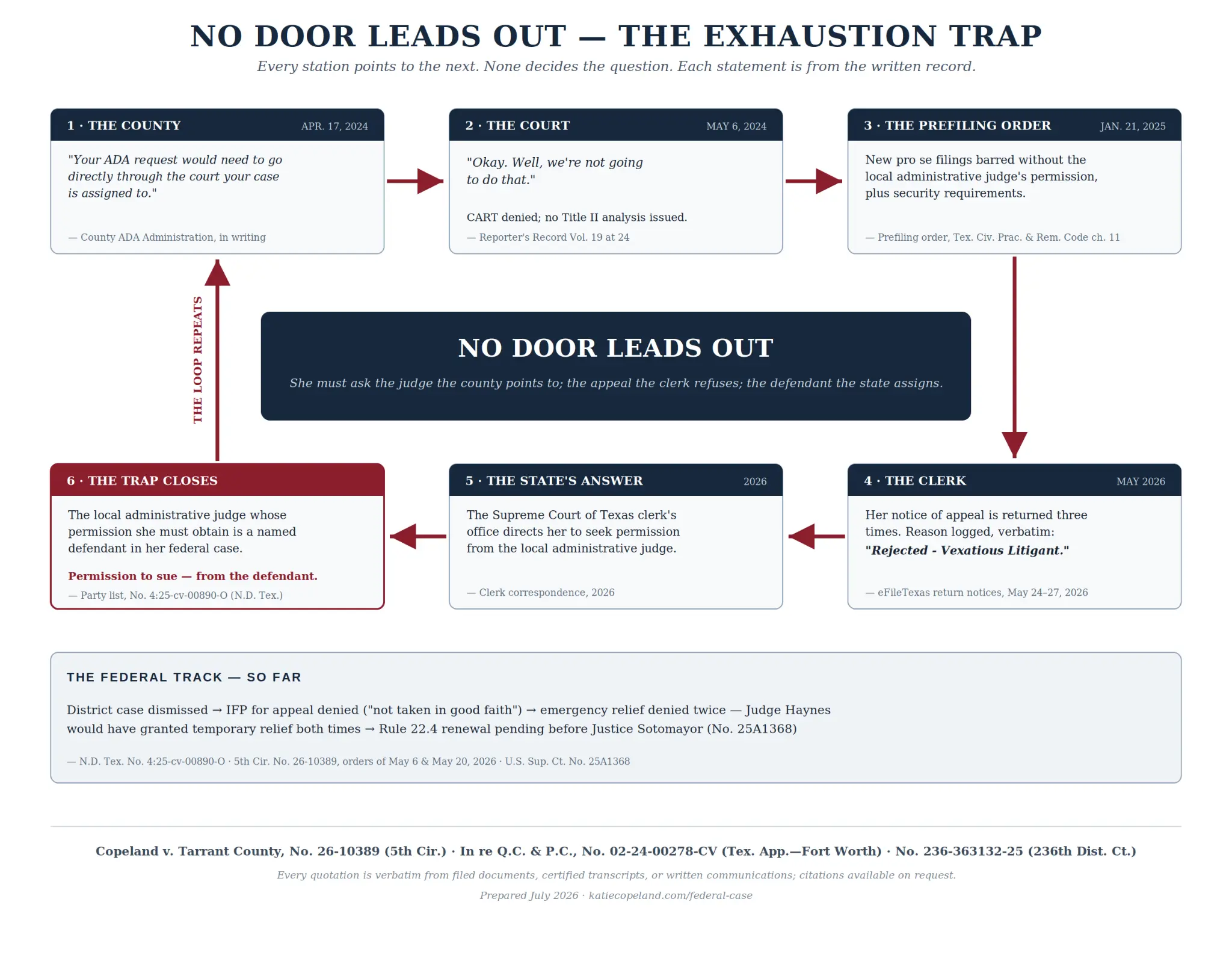
Every station points to the next. None decides the question. Each statement is from the written record. — Copeland v. Tarrant County, No. 26-10389 (5th Cir.) · No. 4:25-cv-00890-O (N.D. Tex.)
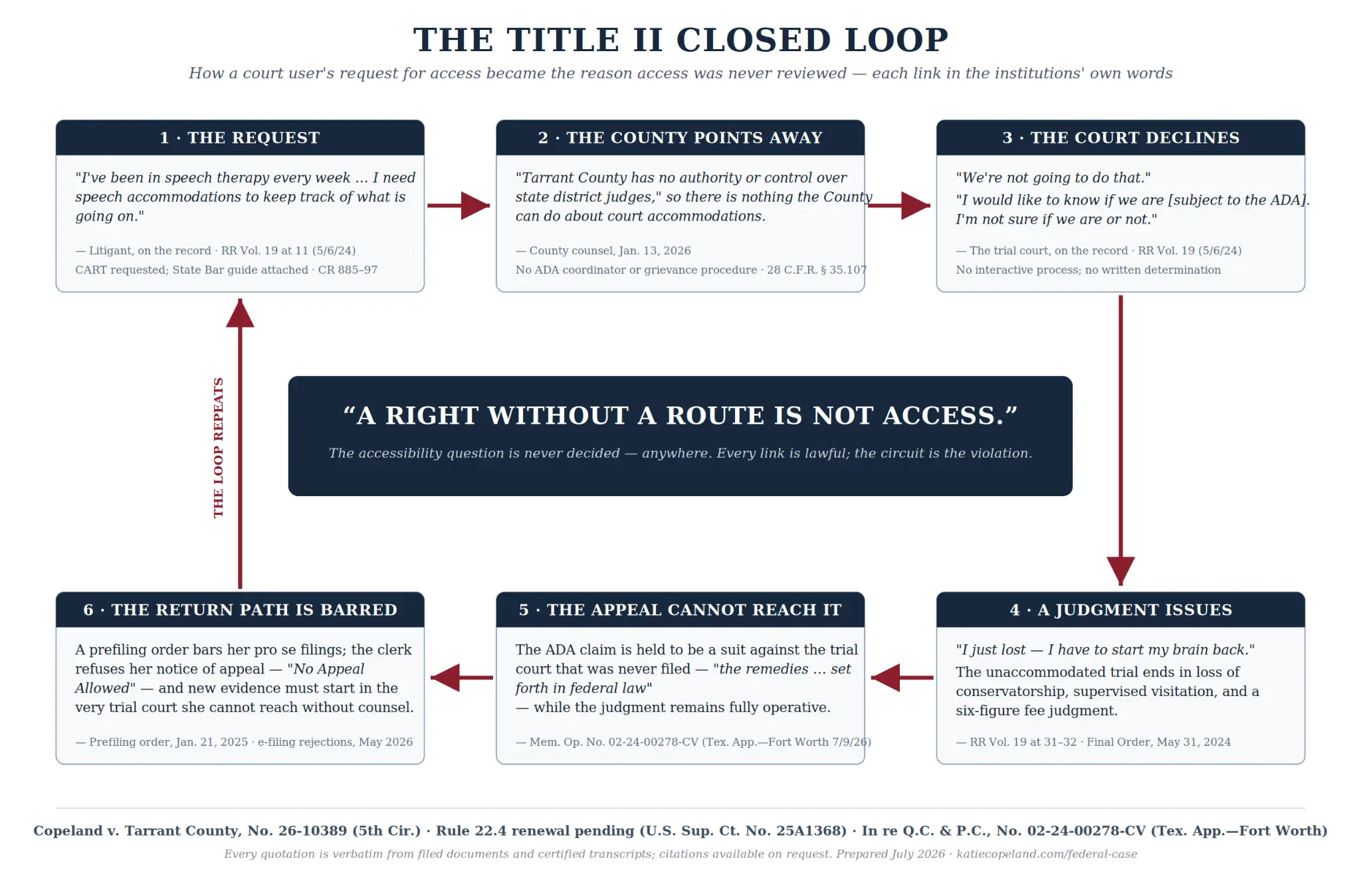
How a court user's request for access became the reason access was never reviewed — each link in the institutions' own words. Every quotation verbatim from filed documents and certified transcripts; citations available on request.
The claim, and what proves it. The structural claim is established by the County's own written admissions — no coordinator, no self-evaluation, no grievance procedure — and under Luke v. Texas, 46 F.4th 301 (5th Cir. 2022), the resulting lack of meaningful access "is itself the harm." The individual denial of access is documented by the proceedings themselves: accommodation requests beginning April 2023 (ten accommodations sought, before any trial); a medical collapse requiring emergency evaluation at the August 17, 2023 trial (RR Vol. 11–12); a default judgment entered three days after the amended ADA motion with a speech-language pathologist's evaluation attached (later set aside); renewed requests denied at the May 2024 proceeding with the court stating "We're not going to do that" (RR Vol. 19 at 24), followed by a documented cognitive collapse on the record ("I just lost — I have to start my brain back," RR Vol. 19 at 31–32); and the court proceeding with the morning of day two in her absence — she reached the courtroom after the lunch recess with her personal care attendant's assistance and participated through the afternoon (RR Vol. 20). The Social Security Administration has since adjudicated her totally disabled with onset June 8, 2023 — before the first trial and every collapse, and eleven months before the State argued on the record that she was "talking disabled when it's convenient" (RR Vol. 20 at 236). Treating-provider findings (speech-language pathology, 2023; physician certification of cognitive dysfunction impairing real-time oral communication, 2025) complete the foundation. Counsel with views on further forensic communication evidence are invited to share them.
Visual Exhibits
Four curated graphics for counsel, amici, and journalists. Every statement is sourced to filed documents, certified transcripts, or written government communications. Click any image to view full size.
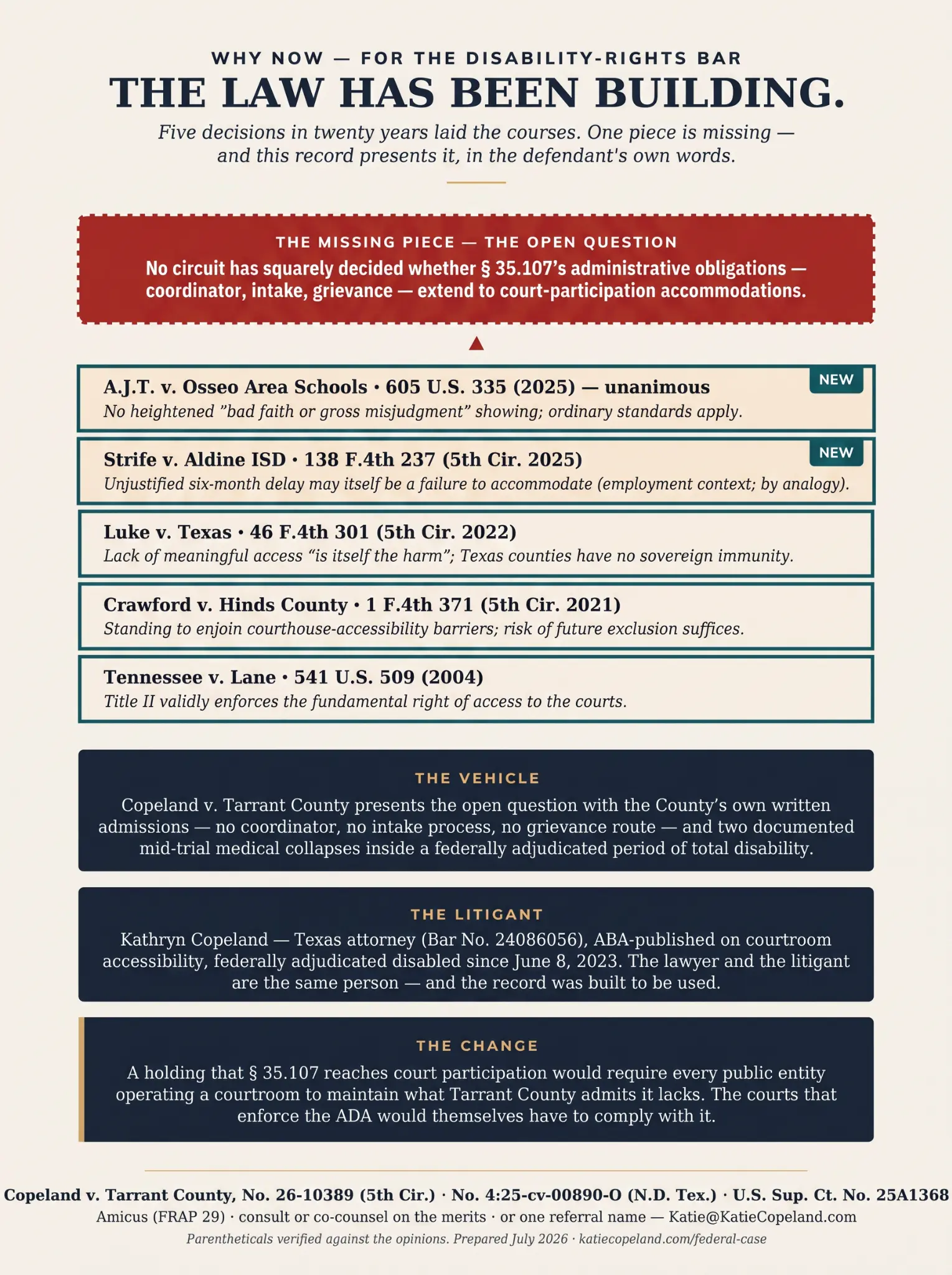
For the disability-rights bar. Five decisions in twenty years laid the courses. One piece is missing — and this record presents it, in the defendant's own words. Amicus (FRAP 29) · co-counsel · or one referral name — Katie@KatieCopeland.com
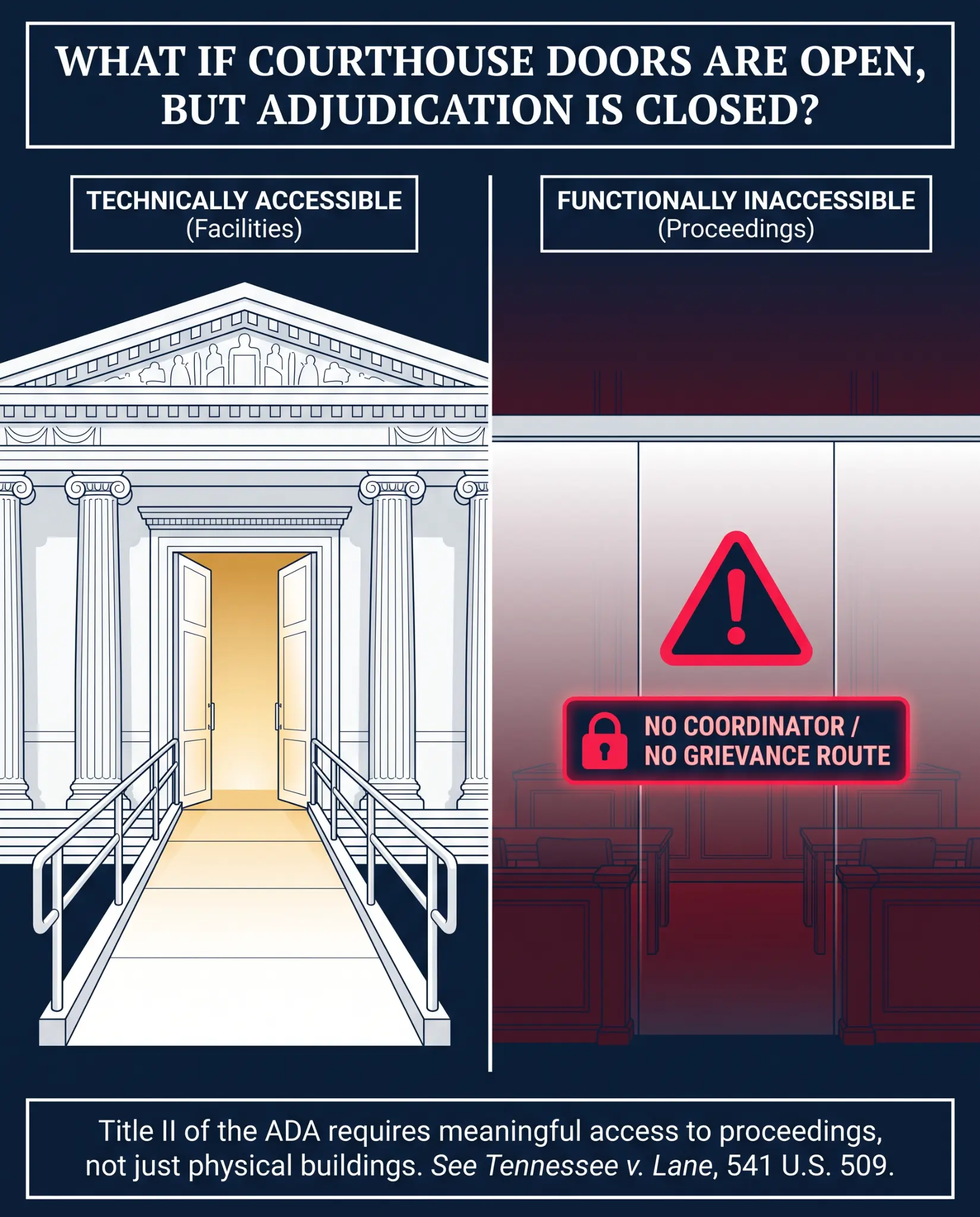
Title II requires meaningful access to proceedings, not just physical buildings. Tennessee v. Lane, 541 U.S. 509 (2004). The facility/proceeding distinction is the open question in this case.
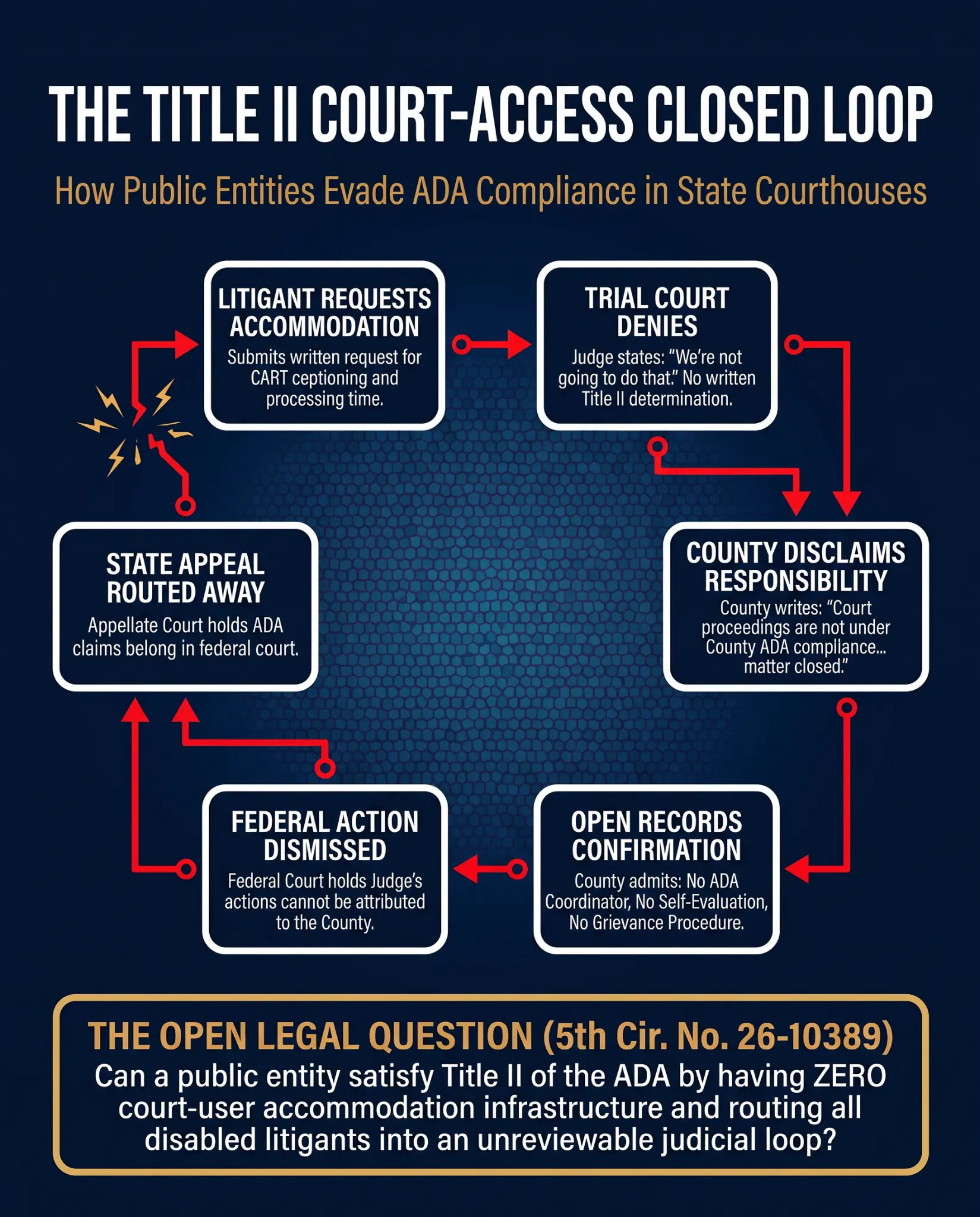
The structural question in No. 26-10389: Can a public entity satisfy Title II by having zero court-user accommodation infrastructure and routing all disabled litigants into an unreviewable loop? Every node sourced to filed documents.
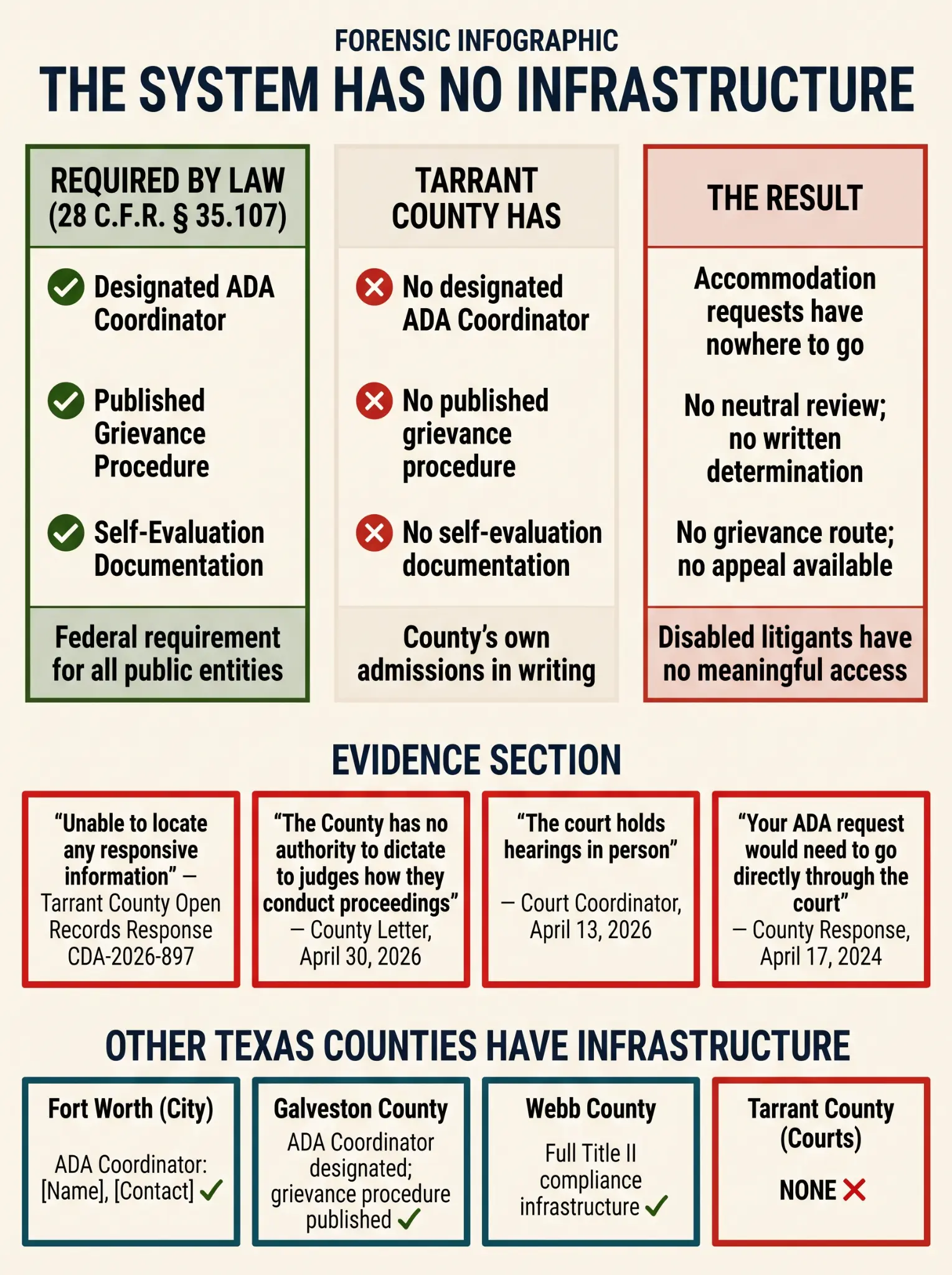
Forensic infographic. Every quotation verbatim from written County correspondence. Source: CDA-2026-897 (April 21, 2026). Comparator counties sourced to publicly available ADA compliance records.
Additional Exhibits — click to expand (7 graphics)
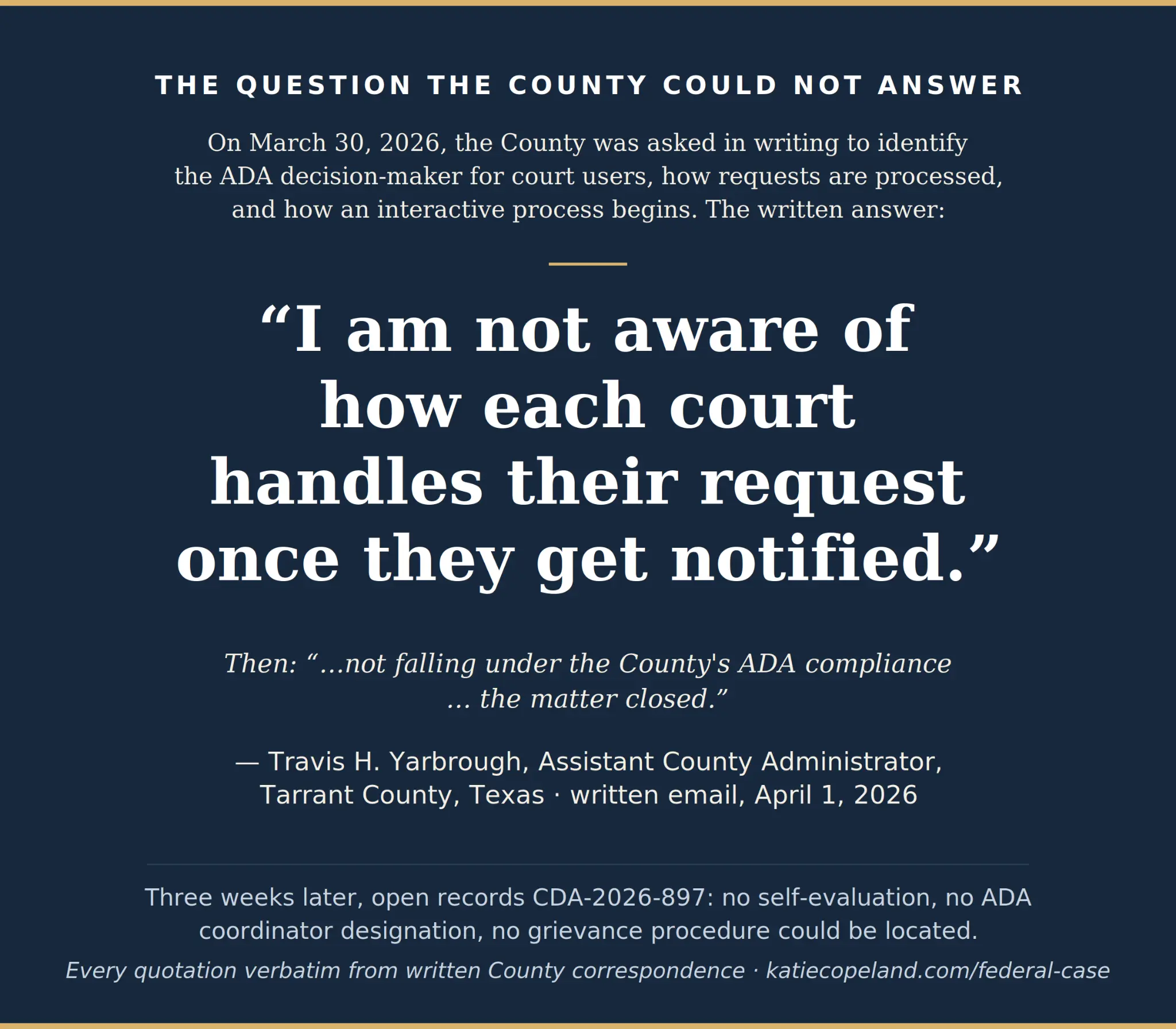
Yarbrough quote card — verbatim, April 1, 2026. Filed as Appendix p. 047.
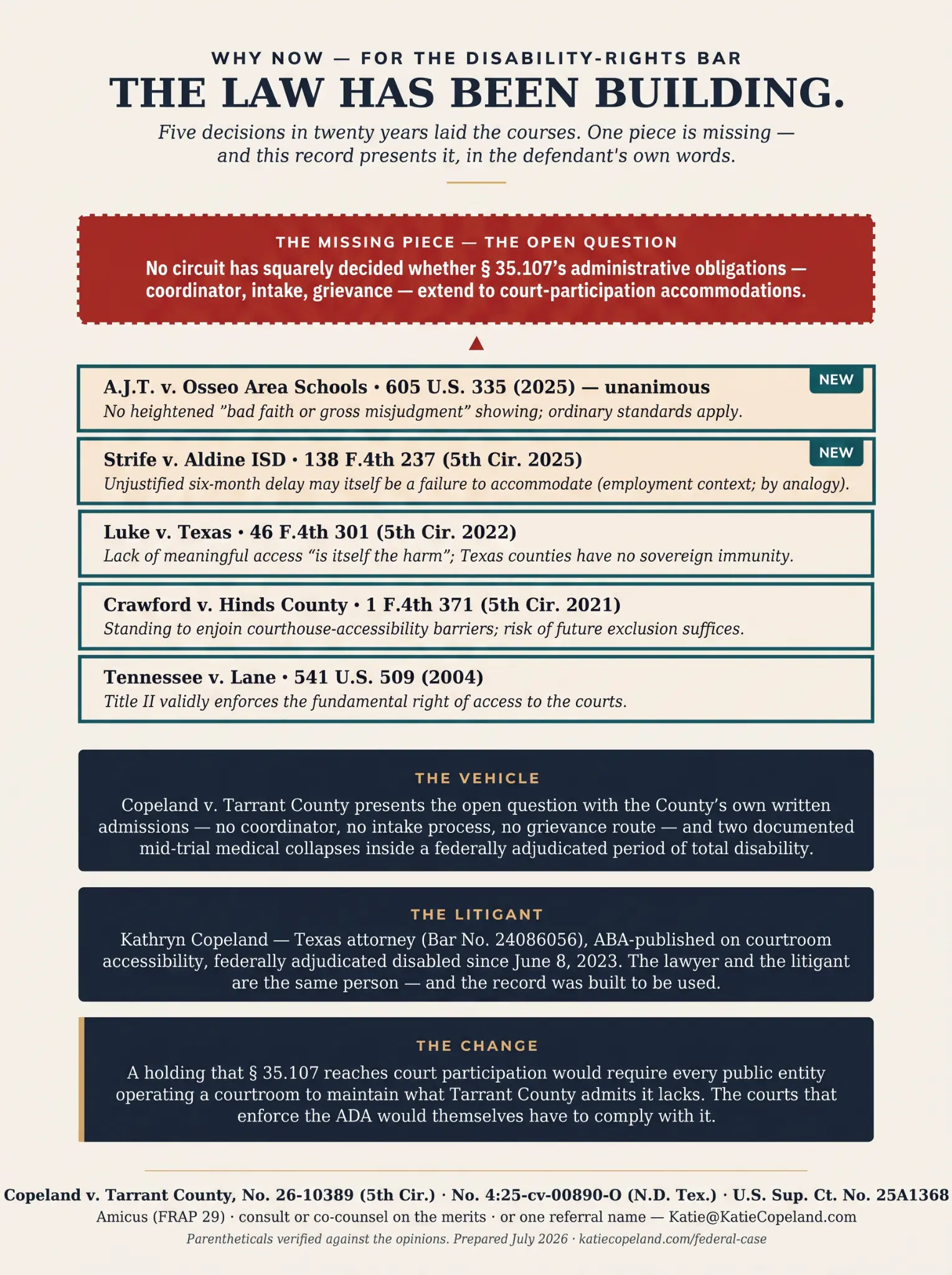
The Law Has Been Building — general version. Five decisions, one open question.
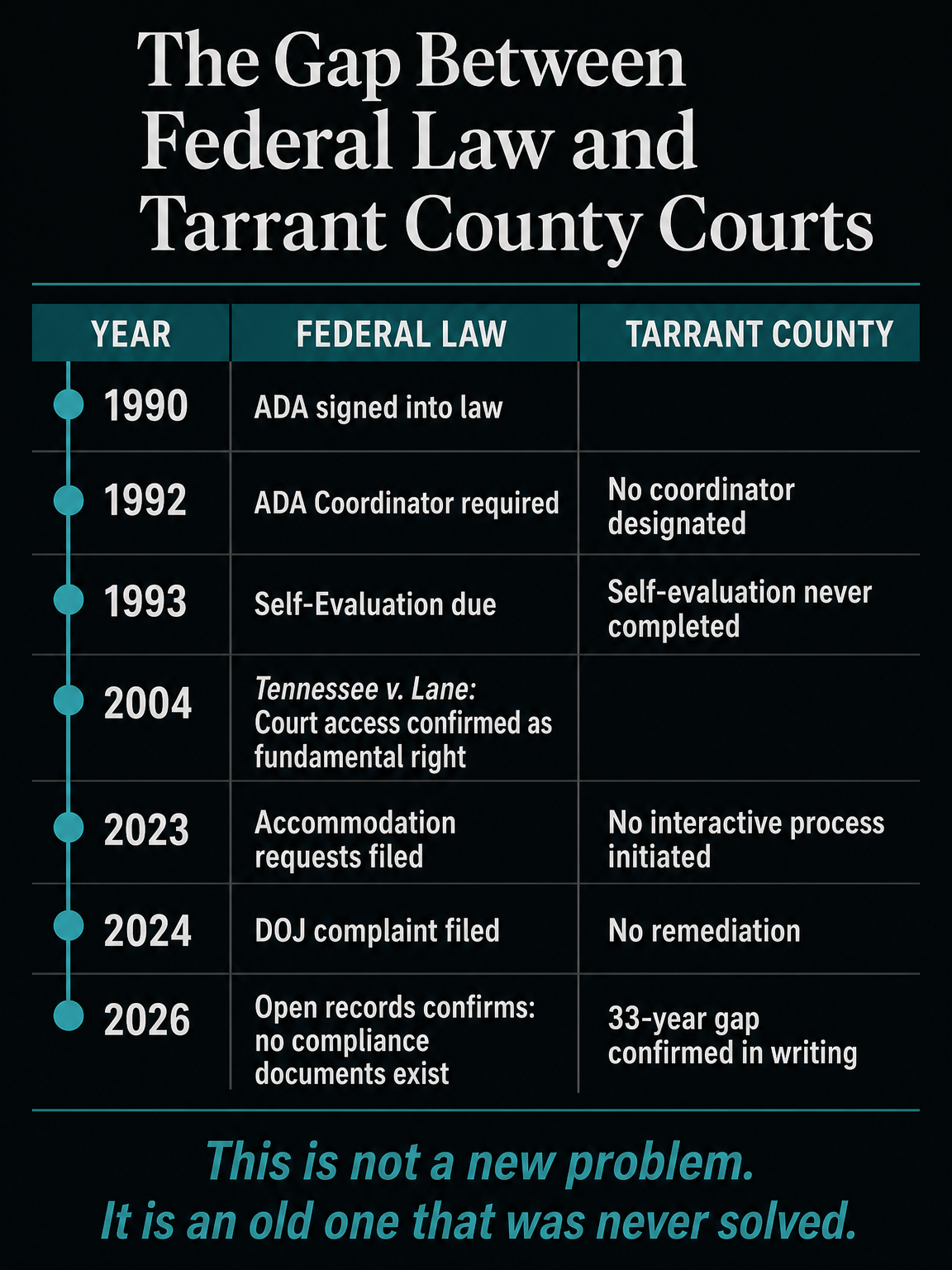
The Gap Timeline — 33-year gap confirmed in writing by CDA-2026-897.
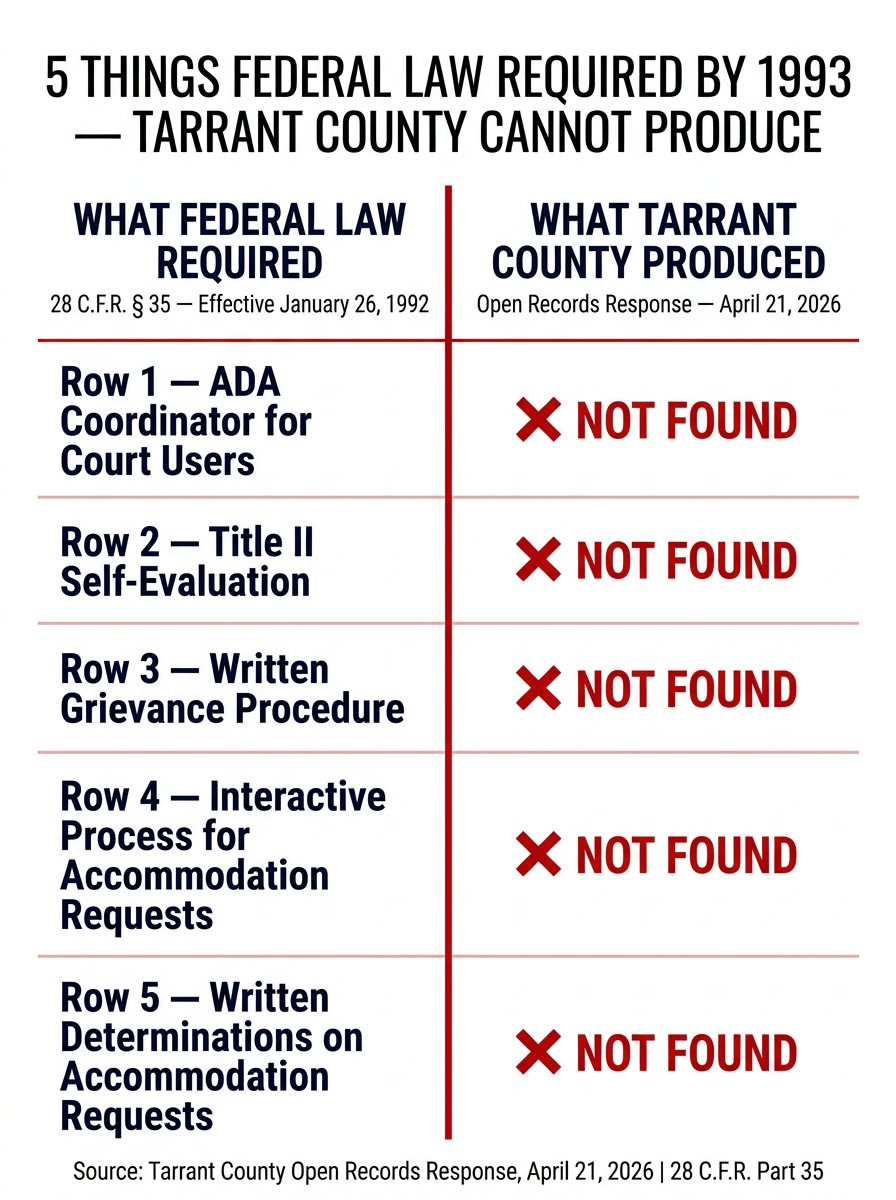
5 Things Federal Law Required by 1993 — Tarrant County Cannot Produce. Source: CDA-2026-897.
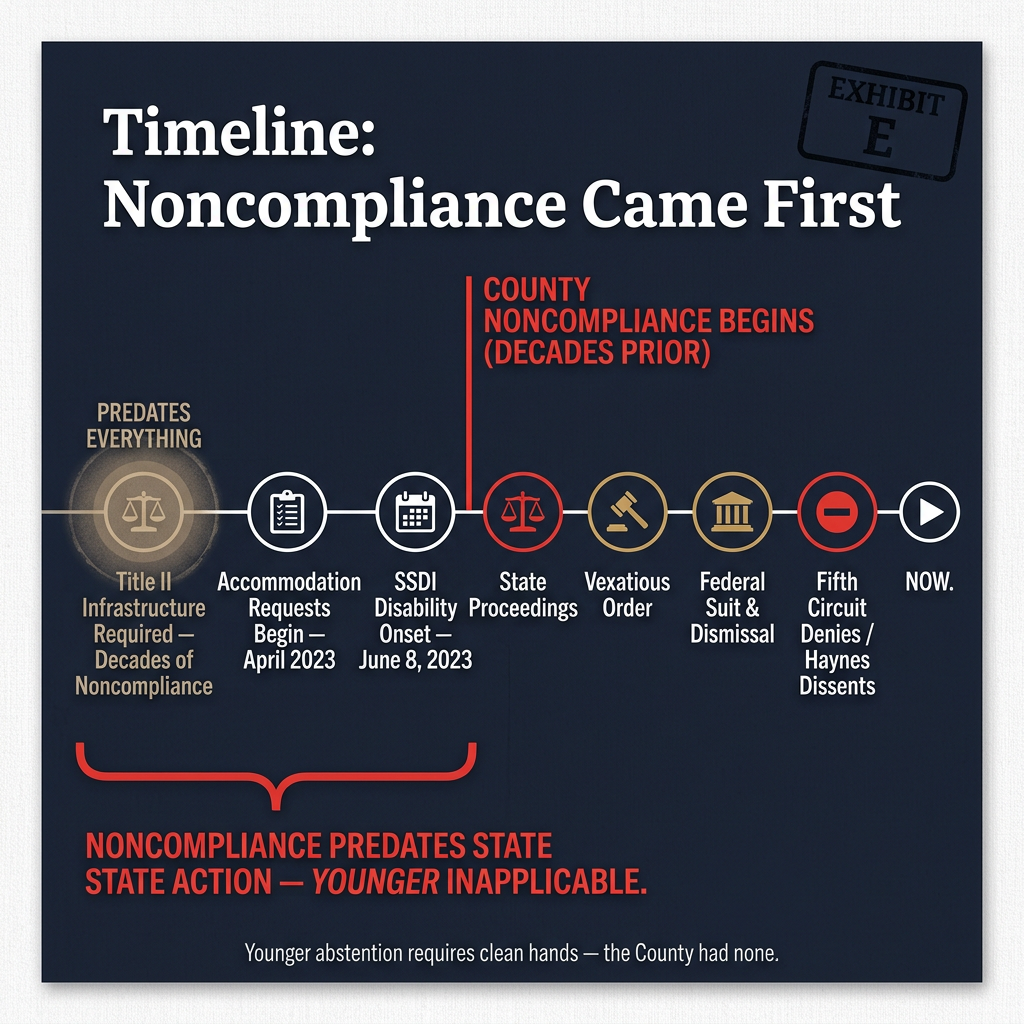
Exhibit E — Noncompliance Came First. Structural noncompliance predates every state proceeding.
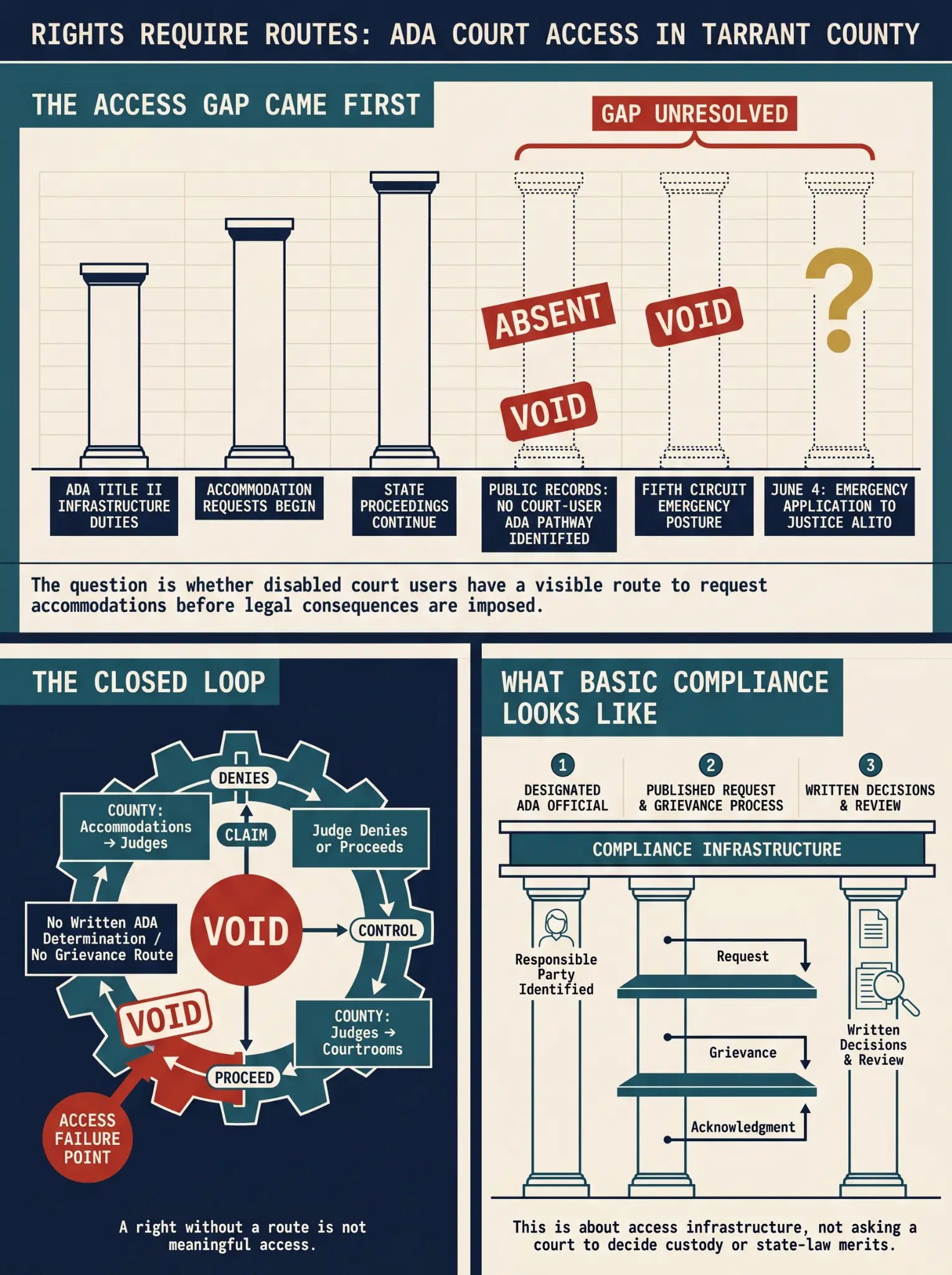
Rights Require Routes — three-panel diagram. A right without a route is not meaningful access.
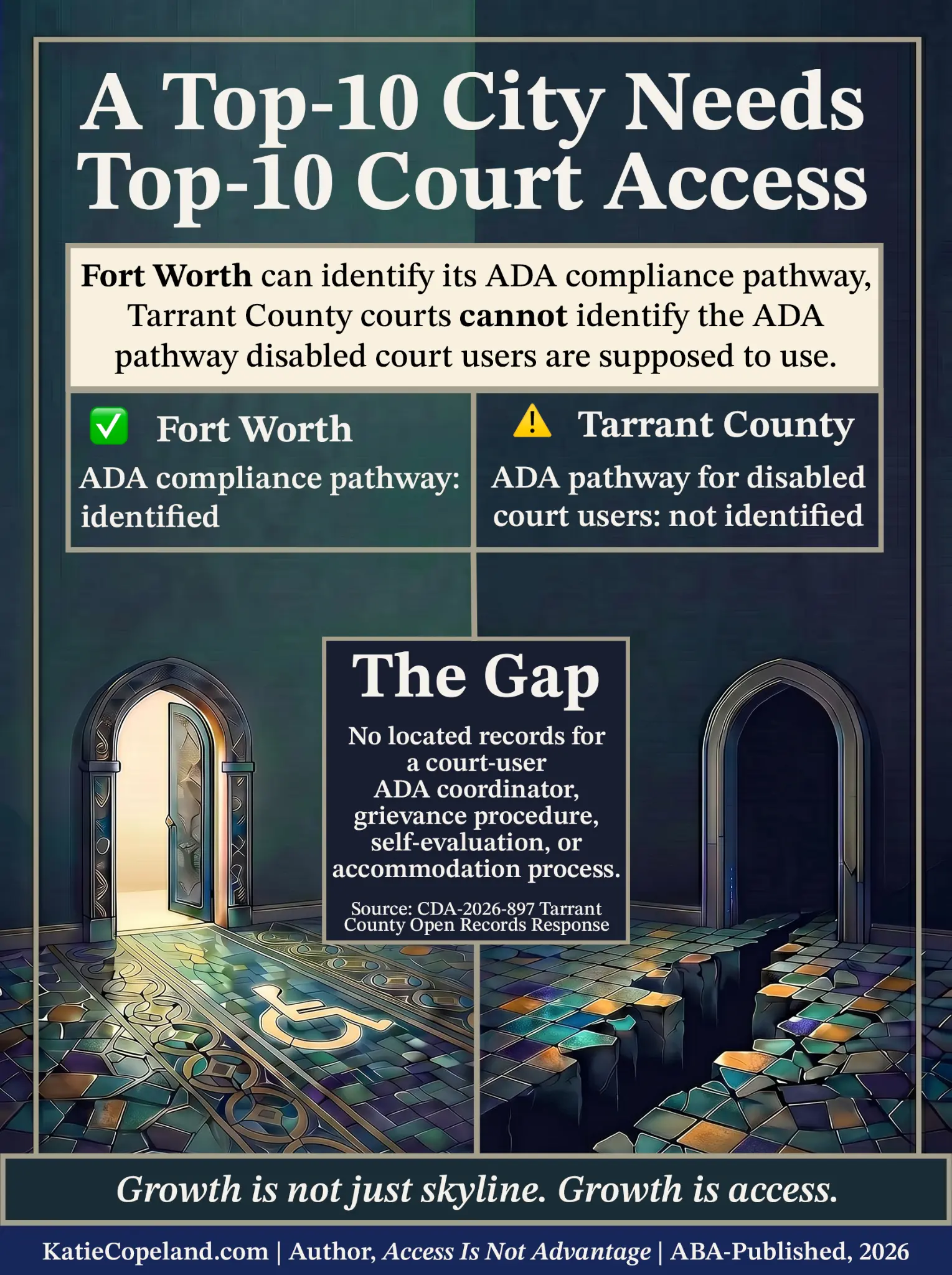
Growth is not just skyline. Growth is access. Source: CDA-2026-897.
Procedural Timeline
- April 2023 First ADA accommodations motion filed — ten accommodations requested, before any trial. No interactive process; no written determination.
- August 17, 2023 — Collapse No. 1 Medical collapse requiring emergency evaluation during trial. Blood-sugar reading documented on the record; ER discharge discussed the following morning (RR Vols. 11–12).
- November 10–13, 2023 Amended ADA motion filed with speech-language pathologist's evaluation attached. Default judgment entered three days later — later set aside.
- April 17, 2024 County ADA Administration, in writing: "Your ADA request would need to go directly through the court your case is assigned to."
- May 6, 2024 — Collapse No. 2 Court states "We're not going to do that" (RR Vol. 19 at 24). Plaintiff suffers documented cognitive collapse on the record: "I just lost — I have to start my brain back" (RR Vol. 19 at 31–32). Court proceeds with morning of day two in plaintiff's absence; she returns after lunch with her personal care attendant and participates through the afternoon (RR Vol. 20).
- May 31, 2024 Final judgment: conservatorship lost; supervised visitation; six-figure attorney's fee award.
- January 21, 2025 Prefiling order entered. Pro se filings now require permission from the local administrative judge — who is a named defendant in the federal case.
- April 10, 2026 Social Security Administration issues fully favorable SSDI determination: total disability with onset June 8, 2023 — before the first trial and every collapse.
- April 21, 2026 Open-records response (CDA-2026-897): County is "unable to locate any responsive information" regarding a designated ADA coordinator, self-evaluation, or grievance procedure — all required since January 26, 1992.
- July 9, 2026 Texas Second Court of Appeals affirms. Memorandum opinion holds ADA claim is a suit against the trial court — "the remedies … set forth in federal law" — while the judgment remains fully operative. Motion for rehearing pending.
- 5th Circuit — No. 26-10389 Two separate orders note Judge Haynes would have granted temporary relief. Docketing fee ($605) paid July 28, 2026 — appeal fully active. Merits briefing schedule pending.
- U.S. Sup. Ct. No. 25A1368 Application (No. 25A1368) submitted to Justice Alito June 4, 2026; denied June 11, 2026. Rule 22.4 Renewal submitted to Justice Sotomayor July 1, 2026 — pending.
Doctrinal Map
Five controlling and persuasive authorities frame the structural claim. Each case PDF is hosted below for counsel's convenience.
- § Tennessee v. Lane, 541 U.S. 509 (2004) — upholding Title II as valid § 5 legislation as applied to cases implicating the fundamental right of access to the courts.
- § Crawford v. Hinds County, 1 F.4th 371 (5th Cir. 2021) — disabled citizen had standing to seek injunctive relief against courthouse-accessibility barriers based on the risk of future exclusion.
- § Luke v. Texas, 46 F.4th 301 (5th Cir. 2022) — lack of meaningful access "is itself the harm" under Title II; Texas counties are political subdivisions with no sovereign immunity.
- § Strife v. Aldine ISD, 138 F.4th 237 (5th Cir. 2025) — reversing dismissal: an unjustified delay in granting an accommodation may itself constitute a failure to accommodate (employment context; principle argued by analogy).
- § A.J.T. v. Osseo Area Schools, 605 U.S. 335, 145 S. Ct. 1647 (2025) — unanimously rejecting any heightened "bad faith or gross misjudgment" showing for ADA/§ 504 claims; ordinary disability-discrimination standards apply.
The open question: No circuit has squarely decided whether § 35.107's administrative obligations — coordinator, intake, grievance — extend to court-participation accommodations. This record presents that question with the County's own written admissions, two dissents from Judge Haynes in the Fifth Circuit, and a fully favorable SSDI adjudication covering the entire period of the alleged violations.
Document Packet
The documents below are organized for counsel review. All are filed public-record documents. Documents bearing minor-children's names in case captions are available on request.
Supreme Court of the United States — No. 25A1368
- Emergency Application for an Injunction Pending Appeal — filed June 4, 2026 (without appendix, 31 pp.)
- Transmittal Letter to SCOTUS Clerk — June 4, 2026
- Rule 22.4 Renewal to Justice Sotomayor — filed July 1, 2026 — pending
- SCOTUS Docket — No. 25A1368 (live, updates automatically) — renewal before Justice Sotomayor, pending
Fifth Circuit — No. 26-10389
- ECF Doc. 15 — Emergency Motion for Injunction Pending Appeal (FRAP 8(a)) — filed May 4, 2026 (available on PACER)
- ECF Docs. 26-1 & 26-2 — Order Denying Injunction Pending Appeal — May 6, 2026 (Judge Haynes would grant temporarily and carry with the case)
- ECF Doc. 39-1 — Motion for Reconsideration of May 6 Order — filed May 19, 2026 (88 pp.)
- ECF Docs. 37-1 & 37-2 — Order Denying Reconsideration — May 20, 2026 (Judge Haynes would still grant it)
Case Law (hosted for convenience)
- Tennessee v. Lane, 541 U.S. 509 (2004)
- Crawford v. Hinds County, 1 F.4th 371 (5th Cir. 2021)
- Luke v. Texas, 46 F.4th 301 (5th Cir. 2022)
- Strife v. Aldine ISD, 138 F.4th 237 (5th Cir. 2025)
- A.J.T. v. Osseo Area Schools, 605 U.S. 335 (2025)
Statutory Framework — Hosted for Convenience
- 42 U.S.C. § 12132 — Title II Prohibition on Discrimination
- 28 C.F.R. § 35.107 — Designation of Responsible Employee and Adoption of Grievance Procedures (as of Aug. 7, 2025)
- 28 C.F.R. § 35.130 — General Prohibitions Against Discrimination (as of Aug. 7, 2025)
- 28 C.F.R. § 35.160 — Communications (as of Aug. 7, 2025)
Additional Materials Available on Request
The following are available to counsel who contact Katie@KatieCopeland.com: the SCOTUS appendix (126 pp., June 4, 2026); the Second Amended ADA Motion with rulings (state trial court, 36 pp.); certified reporter's record volumes (2022–2024); federal district court orders including the Magistrate Judge's FCR (ECF 68); amended opening brief and appellees' response; SSDI fully favorable decision (ALJ Finding 11); treating-provider evaluations (speech-language pathology, 2023; physician certifications, 2025–2026).
For the Disability Rights Bar
The open question in No. 26-10389 has not been decided by any circuit. The record is unusually clean — the defendant’s own written admissions, two dissents from Judge Haynes, and a fully favorable SSDI adjudication. Three bounded asks — any one of which would be meaningful:
One Referral Name
Know a disability-rights attorney, organization, or clinic that handles Title II court-access claims? A single introduction is the most valuable thing anyone can offer. No commitment required beyond the email.
Amicus Participation
FRAP 29 amicus participation is open in the Fifth Circuit (No. 26-10389). The § 35.107 question — whether administrative obligations extend to court-participation accommodations — is ripe for a circuit-level statement from the bar.
Co-Counsel or Consultation
The Fifth Circuit appeal is the live vehicle. A standalone trial-level action with a fully built record is also viable. Fee-shifting available under 42 U.S.C. § 12205. A one-hour consult is welcomed with no further obligation.
Contact: Katie@KatieCopeland.com · (817) 789-8498 · Full explainer →