Copeland v. Tarrant County · No. 26-10389 (5th Cir.) · No. 25A1368 (SCOTUS)

The Question No Court Has Answered

Federal law has required courthouse disability-access infrastructure since 1992. Tarrant County's own records show it doesn't exist. Eight courts have touched this case. Not one has decided whether that matters — yet.

34
Years of Required
Compliance
0
Records Located
by the County
8
Courts. One
Question Unanswered.
1
Judge Who Said
She'd Grant It — Twice
Why This Case Matters Send a Thought

The Law Has Been Building. This Record Completes It.

Five decisions in twenty years laid the courses. One piece is missing — and this record presents it in the defendant’s own words. No circuit has squarely decided whether § 35.107’s administrative obligations — coordinator, intake, grievance — extend to court-participation accommodations. Copeland v. Tarrant County presents that question with an unusually clean record.

The Open Question

No circuit has decided whether § 35.107’s administrative obligations extend to court-participation accommodations. This is the question in No. 26-10389.

The Record

The defendant’s own written admissions. No coordinator, no self-evaluation, no grievance procedure — confirmed by open-records response CDA-2026-897. The central facts are not in dispute.

The Dissent

Judge Jennifer Haynes of the Fifth Circuit stated she would grant temporary relief — twice, in two separate orders. Her dissent is in the record.

The Litigant

Texas attorney, ABA-published on courtroom accessibility, federally adjudicated totally disabled since June 8, 2023. The lawyer and the litigant are the same person — and the record was built to be used.

Three Ways to Help — Easiest First

1. One referral name — an attorney, org, or clinic that handles Title II court-access claims.   2. Amicus participation (FRAP 29).   3. Co-counsel or one-hour consult (fee-shifting available, 42 U.S.C. § 12205).

Send a Note →

What Makes This Different

Most ADA cases argue over whether a specific accommodation was reasonable. This case argues something upstream: the infrastructure to process any accommodation request doesn't exist — and the County admits it in writing.

01

Structural, Not Individual

This is not a dispute about one denied request. It challenges the absence of any entity-level ADA process for court users — no coordinator, no grievance procedure, no written pathway of any kind.

Source: Tarrant County Open Records Response, CDA-2026-897
02

The Defendant Admits It in Writing

The County's own open-records response states it was "unable to locate any responsive information" regarding ADA compliance infrastructure. The central facts are not in dispute.

Source: CDA-2026-897, April 21, 2026
03

Narrow, Process-Only Relief

The relief sought is not a ruling on any state-law merits. It is simply a pause on new deadlines until a lawful ADA pathway is identified. This respects federalism while protecting fundamental rights.

Emergency Application, Relief Requested
04

A Federal Judge Said She'd Grant It — Twice

Judge Jennifer Haynes of the Fifth Circuit twice indicated she would grant temporary relief or carry the issue to the merits panel. Her dissent is in the record.

ECF Docs. 26-1/26-2 and 37-1/37-2, No. 26-10389
05

National Precedent Potential

A holding that § 35.107 reaches court-participation accommodations would require every public entity operating a courtroom to maintain what Tarrant County admits it lacks. The courts that enforce the ADA would themselves have to comply with it.

28 C.F.R. § 35.107; Tennessee v. Lane, 541 U.S. 509 (2004)
06

Disability Adjudicated Before the Proceedings

The Social Security Administration ruled the applicant fully disabled — retroactive to June 8, 2023 — before any of the state proceedings at issue. The harm is not speculative.

SSA Administrative Law Judge, Finding 11, April 10, 2026

What the County Said

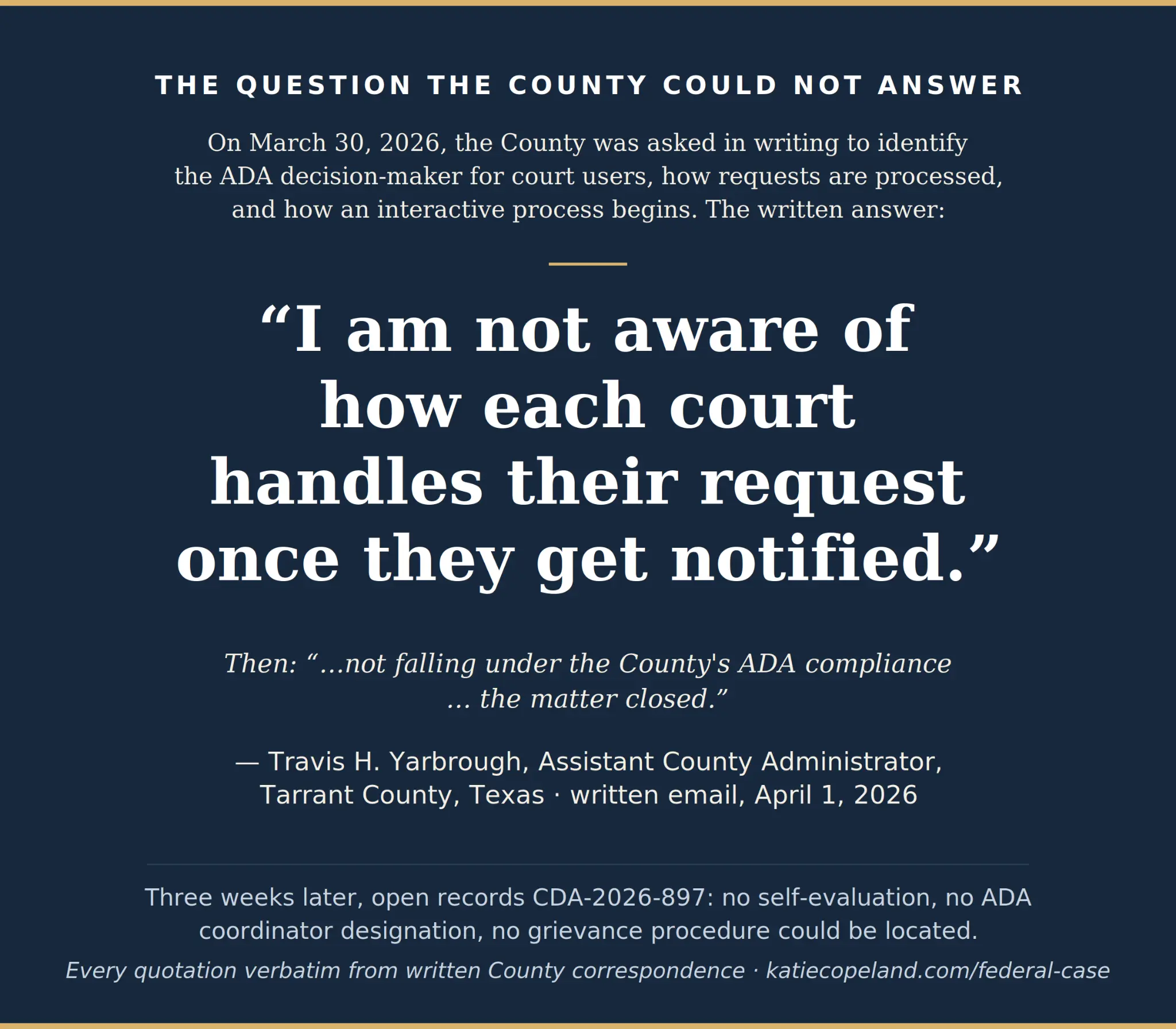
On April 1, 2026, a senior Tarrant County official was asked how the County processes ADA accommodation requests for court users. The response was recorded.

Navy and gold quote card titled 'The Question the County Could Not Answer.' Context text: 'On March 30, 2026, the County was asked in writing to identify the ADA decision-maker for court users, how requests are processed, and how an interactive process begins.' Large-print verbatim quotation: 'I am not aware of how each court handles their request once they get notified.' Below in italic: 'Then: not falling under the County’s ADA compliance… the matter closed.' Attribution: Travis H. Yarbrough, Assistant County Administrator, Tarrant County, Texas · written email, April 1, 2026. Footer: 'Three weeks later, open records CDA-2026-897: no self-evaluation, no ADA coordinator designation, no grievance procedure could be located. Every quotation verbatim from written County correspondence.' Source: Tarrant County email April 1, 2026, filed as Appendix p. 047 in Copeland v. Tarrant County, No. 4:25-cv-00890-O (N.D. Tex.); Open Records Response CDA-2026-897, April 21, 2026.
From the Record
“Okay. Well, we’re not going to do that.”

— The Court, responding to the ADA accommodation request, before granting a ten-minute break to review the pending motions.

RR Vol. 19, p. 24, ll. 1–7 (May 6, 2024)

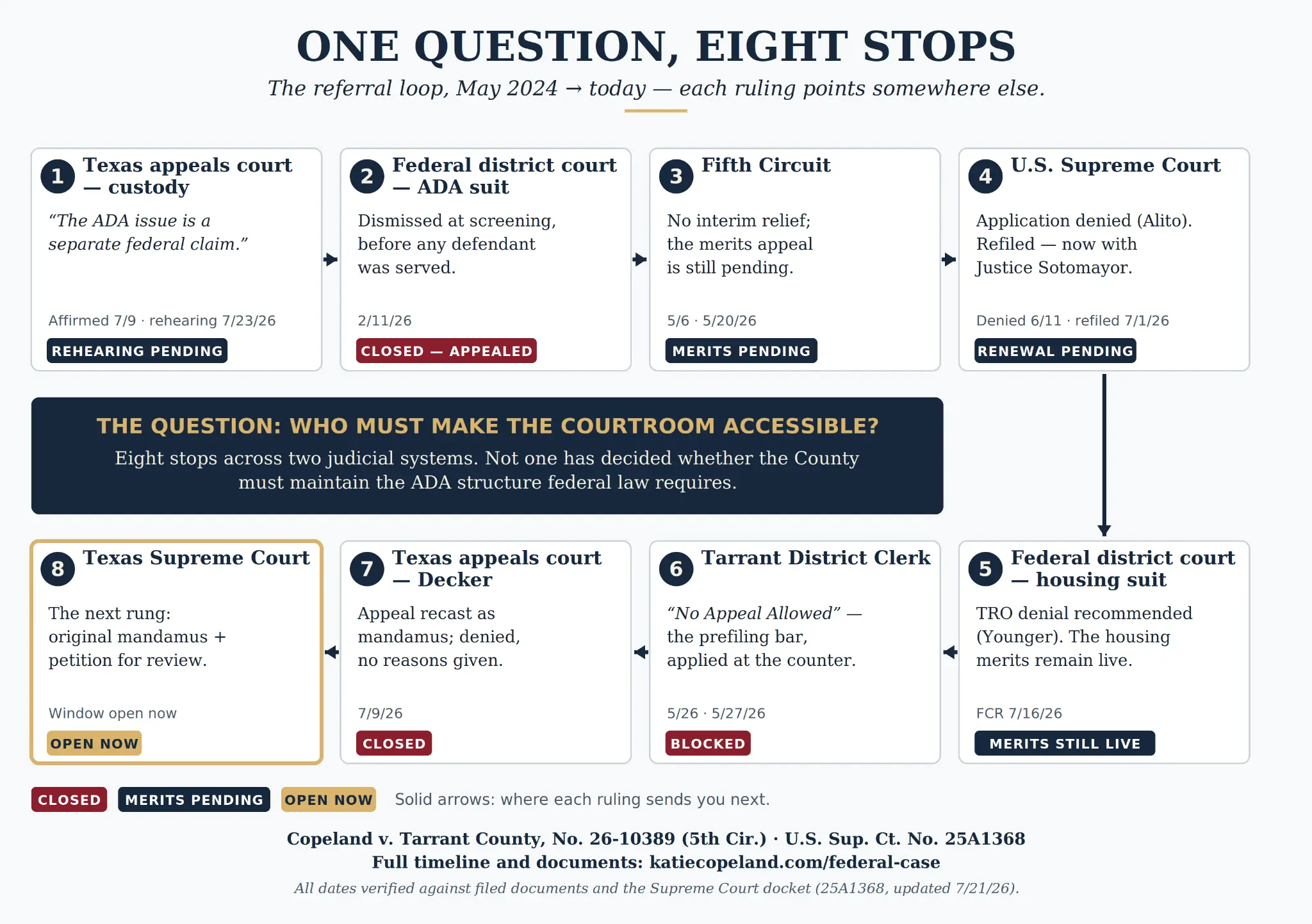
One Question, Eight Stops

Eight courts across two judicial systems have touched this case. Each ruling points somewhere else. Not one has decided the underlying question.

Thumbnail of the One Question Eight Stops referral loop diagram showing eight courts connected in a closed loop with red arrows.

Every ruling routes the question somewhere else. The loop closes on itself — and the underlying ADA question remains unanswered at every stop.

Open full interactive map ⇗

What the Evidence Shows

Every graphic below is sourced to filed documents, certified transcripts, or written government communications. Click any image to view full size.

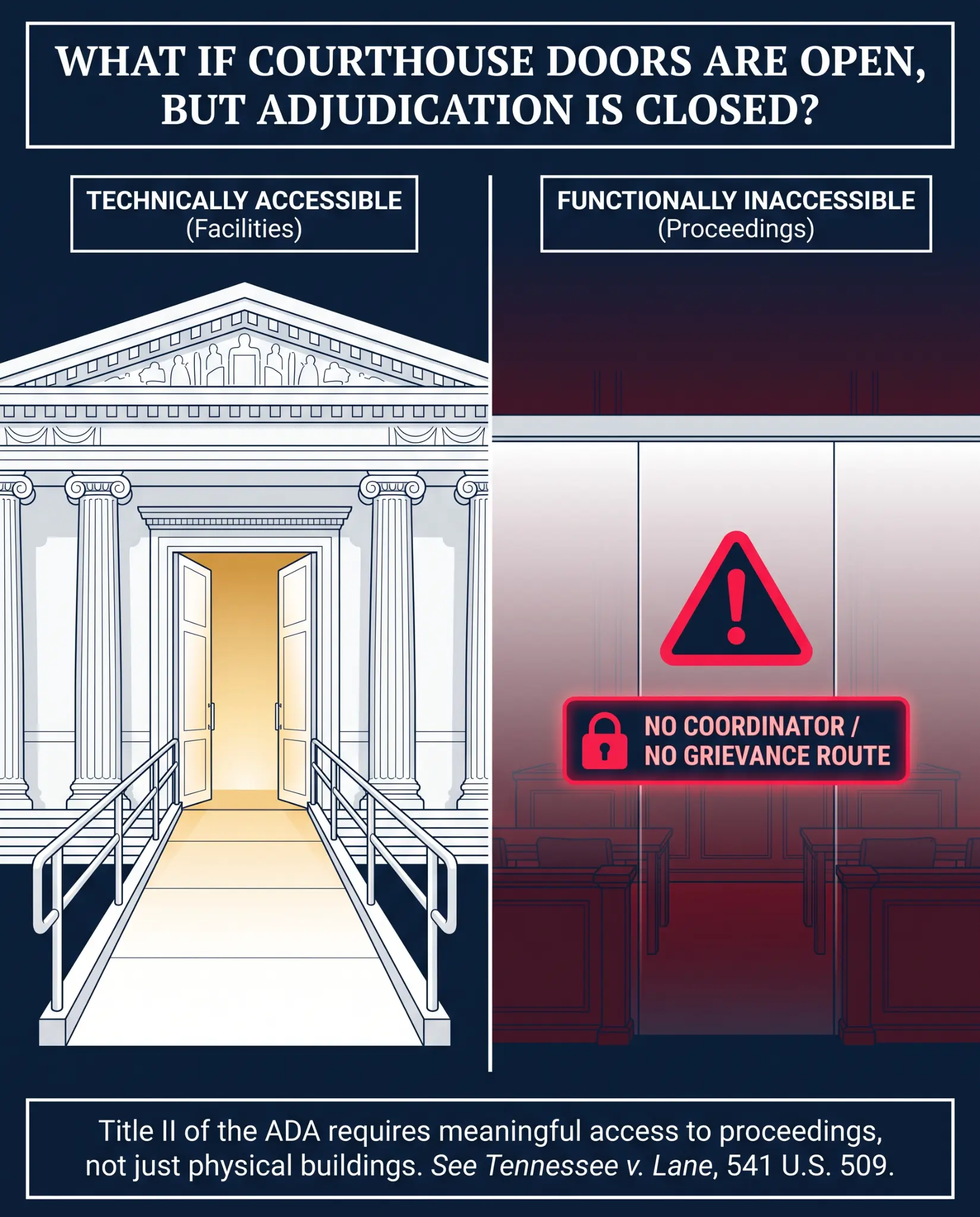
Split-panel infographic on a navy background titled 'What If Courthouse Doors Are Open, But Adjudication Is Closed?' Left panel: 'Technically Accessible (Facilities)' — illustration of a courthouse exterior with open doors, a ramp, and accessible entrance. Right panel: 'Functionally Inaccessible (Proceedings)' — illustration of a darkened courtroom interior with a red warning triangle and a padlock sign reading 'No Coordinator / No Grievance Route.' Footer: 'Title II of the ADA requires meaningful access to proceedings, not just physical buildings. See Tennessee v. Lane, 541 U.S. 509.' The graphic illustrates the distinction between physical facility accessibility and procedural accessibility at the heart of the open question in No. 26-10389.

Title II of the ADA requires meaningful access to proceedings, not just physical buildings. See Tennessee v. Lane, 541 U.S. 509 (2004).

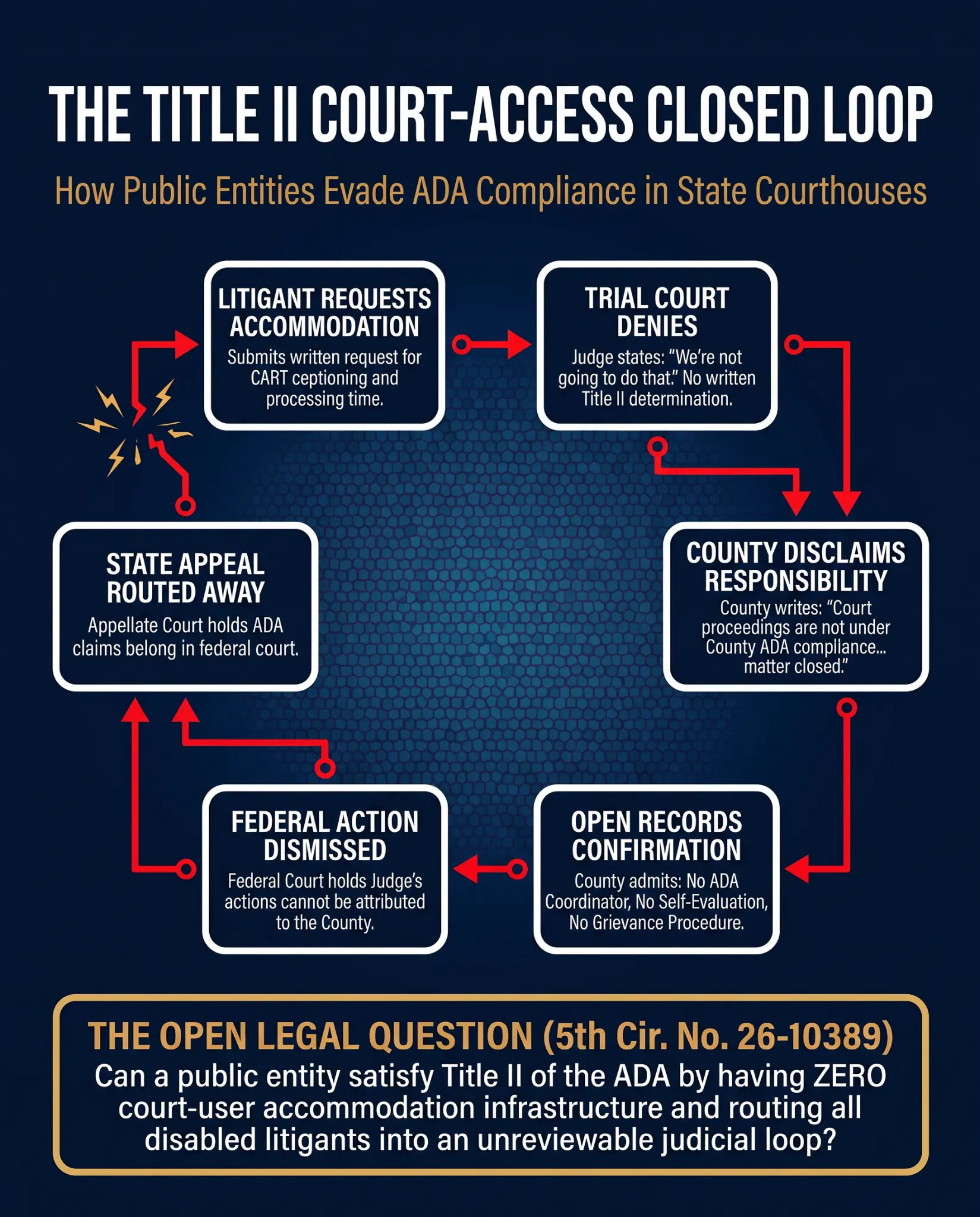
Dark navy circular flow diagram titled 'The Title II Court-Access Closed Loop.' Six white-bordered nodes connected by red arrows in a clockwise closed loop: (1) Litigant Requests Accommodation — submits written request for CART captioning and processing time; (2) Trial Court Denies — judge states 'We're not going to do that,' no written Title II determination; (3) County Disclaims Responsibility — county writes 'Court proceedings are not under County ADA compliance… matter closed'; (4) Open Records Confirmation — county admits no ADA Coordinator, no Self-Evaluation, no Grievance Procedure; (5) Federal Action Dismissed — federal court holds judge's actions cannot be attributed to the County; (6) State Appeal Routed Away — appellate court holds ADA claims belong in federal court. Gold-bordered bottom banner: 'The Open Legal Question (5th Cir. No. 26-10389): Can a public entity satisfy Title II of the ADA by having zero court-user accommodation infrastructure and routing all disabled litigants into an unreviewable judicial loop?' Every node sourced to filed documents, written correspondence, or certified transcripts.

The structural question in No. 26-10389: Can a public entity satisfy Title II by having zero court-user accommodation infrastructure and routing all disabled litigants into an unreviewable loop? Every node sourced to filed documents.

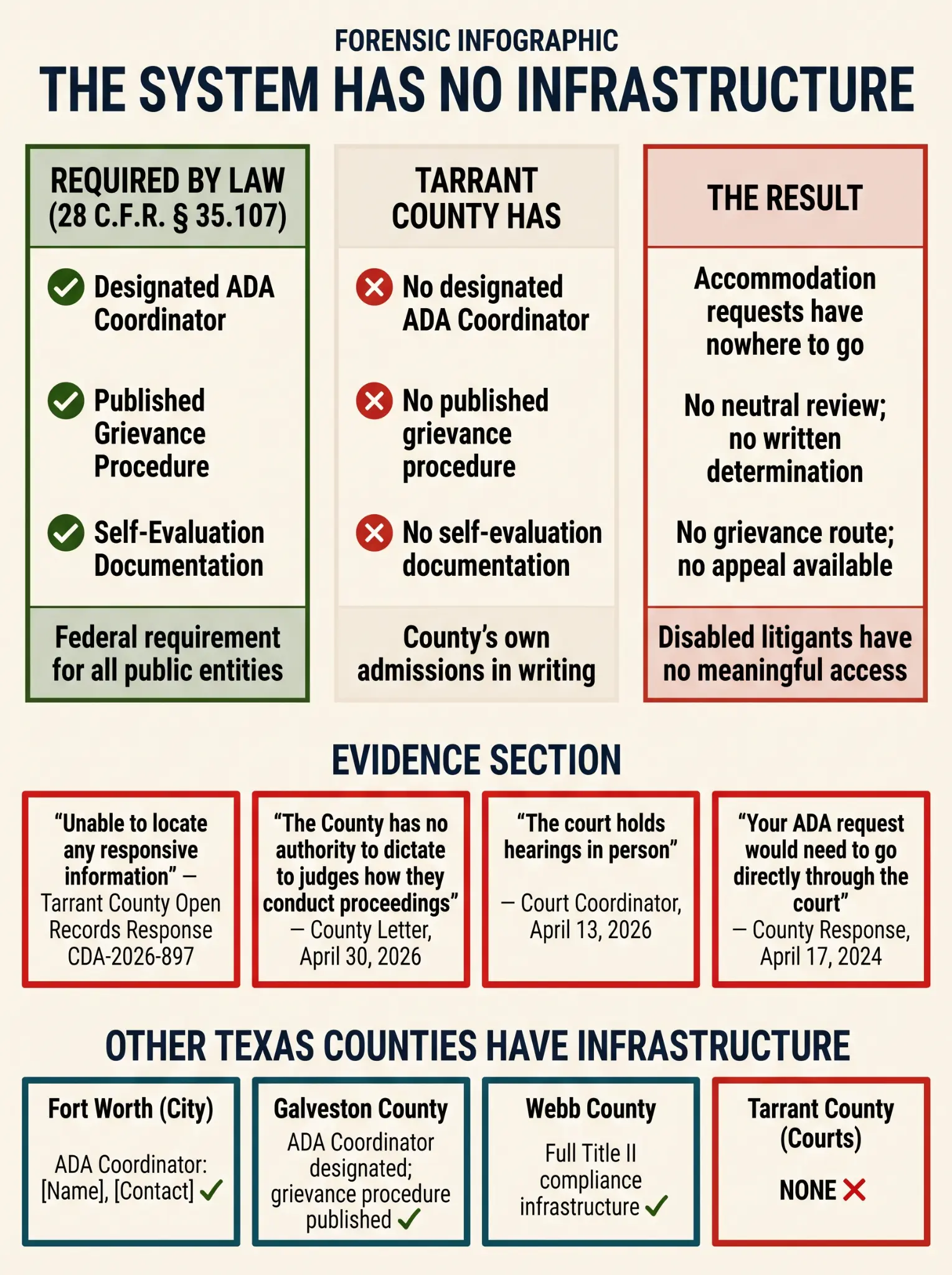
Tall forensic infographic titled 'The System Has No Infrastructure.' Three-column comparison: Left (green border) 'Required by Law (28 C.F.R. § 35.107)' — Designated ADA Coordinator, Published Grievance Procedure, Self-Evaluation Documentation, all with checkmarks, labeled 'Federal requirement for all public entities.' Center 'Tarrant County Has' — all three items marked with red X, labeled 'County's own admissions in writing.' Right (red border) 'The Result' — Accommodation requests have nowhere to go; No neutral review, no written determination; No grievance route, no appeal available; labeled 'Disabled litigants have no meaningful access.' Evidence Section with four verbatim County quotes. Comparator section: Fort Worth (City) and Galveston County and Webb County all have ADA infrastructure; Tarrant County Courts: NONE. Source: CDA-2026-897, April 21, 2026; County correspondence 2024–2026.

Forensic infographic. Every quotation verbatim from written County correspondence. Source: CDA-2026-897 (April 21, 2026) and County letters. Comparator data sourced to publicly available county ADA compliance records.

Full visual exhibit set — katiecopeland.com/federal-case ⇗

What a Decision Would Mean

Send a Thought

If you are a lawyer, scholar, journalist, advocate, or someone who sees something here — send a note directly. No email app needed. Ideas, introductions, resources, and questions are all welcome.

Messages go directly to Kathryn Copeland. Responses are not guaranteed but every message is read.
Messages may be used to inform future advocacy work. No personal information will be published without consent.

Know Someone Who Should See This?

Forward this page to a disability rights attorney, law professor, journalist, or advocate who cares about court access.